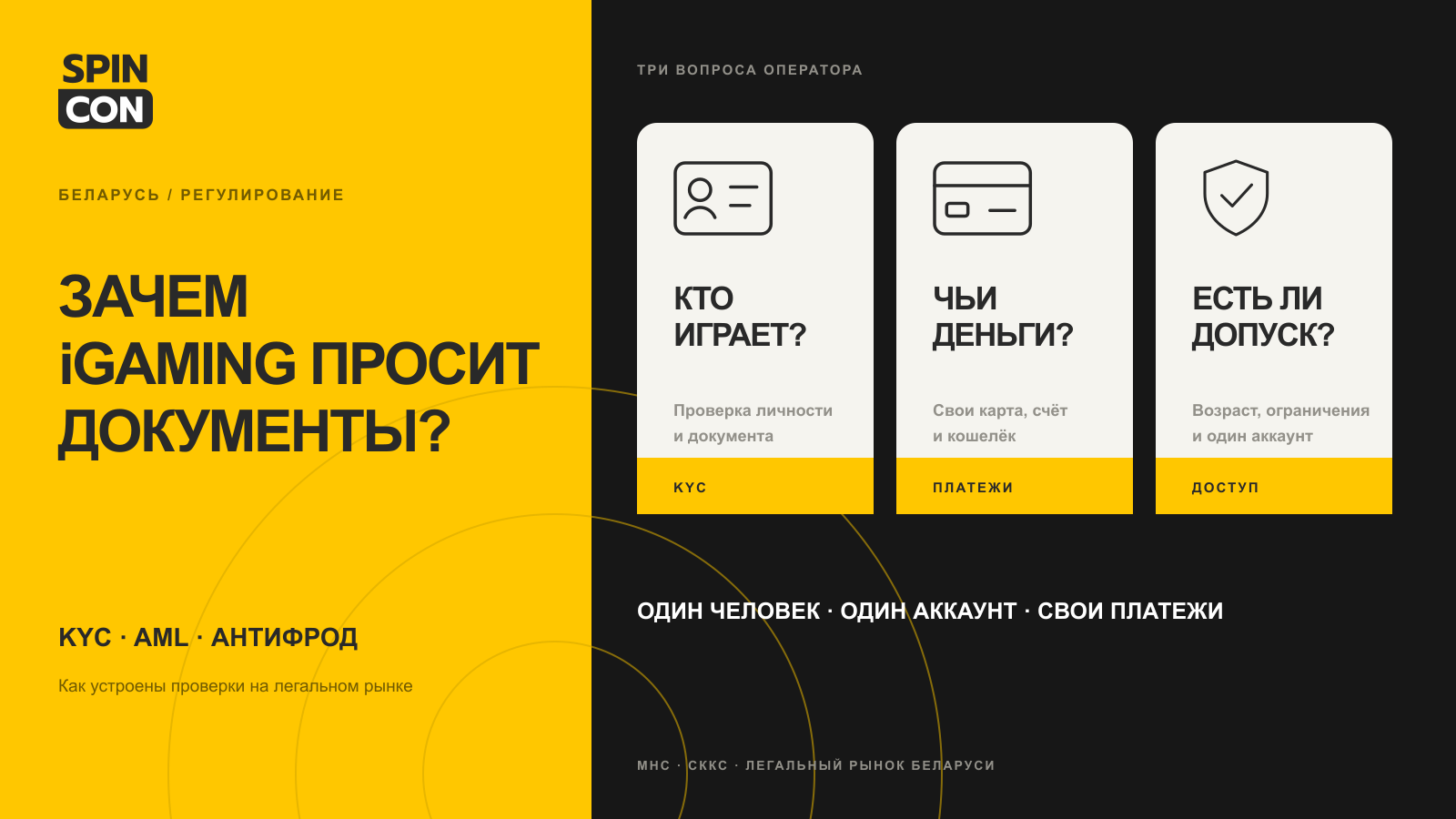
Passport checks, video verification, payment-card ownership checks and restrictions on duplicate accounts may look like extra friction between registration and play. In Belarus's regulated market, these are not arbitrary requirements created by individual companies. They form a system connecting the player, account, payments and state oversight.
The industry often calls this process KYC, meaning Know Your Customer. Belarusian practice, however, goes beyond taking a photo of an identity document. It combines identification, financial controls, fraud prevention and restrictions on access to gambling.
What changed on 11 March 2026
The main provisions of Presidential Edict No. 226 of 6 June 2025, “On Activities in the Gambling Business”, took effect on 11 March 2026.
The most visible changes for players include:
- stronger identity and payment-instrument verification;
- the principle of one player and one account within one virtual gambling establishment;
- banks no longer processing payments from Belarusian citizens to foreign gambling operators;
- Belarusian virtual gambling establishments operating under the updated requirements.
The Ministry of Taxes and Duties explains these changes in its official commentary on Edict No. 226.
The Ministry implements state policy, licenses gambling activity and supervises compliance, including requirements aimed at preventing money laundering. These responsibilities are described by the Ministry's dedicated gambling-control unit.
KYC in Belarus is more than showing a passport
Before allowing a person to gamble, an operator must establish who is creating the account and participating in gambling.
The identity document must be valid
Players presenting an invalid identity document are not admitted. Operators also compare registration information with the person's verified details.
Online registration requires identity confirmation
When registering with a virtual gambling establishment, a player must complete virtual registration through an online video session or visit a land-based gambling venue belonging to that operator.
The updated framework also provides for stronger multi-factor authentication and the use of a player's image in online checks. Gambling is not permitted without completed identification and verification. The Ministry summarised the current player-facing requirements in its guidance dated 14 July 2026.
One person may have one account
A player may have one gaming account within a single virtual gambling establishment. Duplicate accounts must be blocked.
This connects activity, payments and access restrictions to one verified person rather than several disconnected profiles.
Why another person's card cannot be used
A Belarusian operator checks ownership of:
- bank accounts;
- payment cards;
- electronic wallets;
- payment details used for winnings or refunds.
Players cannot fund an account from another person's account or withdraw money to third-party payment details. This applies to cards and accounts belonging to friends, spouses, parents or colleagues.
If the payment instrument does not belong to the player, the transfer for gambling or the payment of winnings is not processed.
The practical rule is simple: the identity document, gaming account and payment instrument must belong to the same person.
KYC, AML and antifraud are not the same thing
The terms are often grouped together, but they solve different problems.
- KYC answers “who is this player?” It covers identification, document checks and identity verification.
- AML aims to prevent a gambling platform from being used to launder criminal proceeds, finance terrorism or support other prohibited financial schemes.
- Antifraud detects abuse such as third-party documents and cards, duplicate accounts, account sharing or other attempts to bypass rules.
KYC and AML are grounded in legal requirements. Antifraud is more often an operational name for an operator's internal technology and processes. Many specific antifraud-style checks, including document validity and payment ownership, are nevertheless expressly required by Belarusian regulation.
An additional check does not automatically mean that a player is suspected of wrongdoing. The operator must establish that both the participant and the transaction comply with the rules.
What the SKKS system does
Belarus's regulated market uses the Special Computer Cash System, known as SKKS. It supports state oversight of gambling turnover, while operators transmit the information and game rules required by law.
The connection between a verified person and financial operations became even more visible in 2026.
From 1 January 2026, Belarusian operators withhold personal income tax at 5% when paying winnings. The income and withheld tax are recorded in SKKS for each recipient. The Ministry explains this in its guidance on the taxation of winnings.
There is also a separate rule for withdrawing funds from an online gaming account: at least 70% of the player's deposited money must have been used for wagers. This is not a KYC rule, but it illustrates why an operator needs to track the flow of funds within one verified account.
Verification also protects access to gambling
Operators must prevent people who are not legally eligible from participating. Gambling in Belarus is restricted to people aged 21 and over, and a unified restriction mechanism is in place.
An individual may voluntarily exclude themselves from gambling for a period of six months to three years. A court may also impose a restriction when gambling places the person or their family in serious financial difficulty.
As of 1 June 2026, 74,056 people had an active restriction, including 44,445 who had excluded themselves voluntarily, according to the Ministry of Taxes and Duties.
Without reliable identification, operators could not properly check age or determine whether a player appears on the restricted-person list.
What players should remember
- Use only your own identity documents, cards, accounts and electronic wallets.
- Do not create duplicate accounts within one virtual gambling establishment.
- Do not share your login, password or account access.
- Be prepared to complete video or in-person verification.
- Before wagering, read the rules for play, winnings, refunds and bonuses.
- Check that the operator holds a Belarusian licence.
- If gambling stops being entertainment, use limits or voluntary self-exclusion.
What this means for the market
KYC in Belarusian iGaming should not be viewed only as an inconvenient registration step. It is part of the legal market's infrastructure.
For players, it means more checks but also reduces the risk of third-party identities and payment instruments being used. For operators, it involves a multidisciplinary team across compliance, AML, antifraud, payments, customer support, product and information security.
The central objective is straightforward: the operator must know who is gambling, whose funds are being used and whether the person is legally eligible to participate.
This article is for informational purposes and does not constitute legal advice. Requirements and official guidance were reviewed as of 22 July 2026. Gambling is restricted to people aged 21 and over and involves the risk of financial loss.